
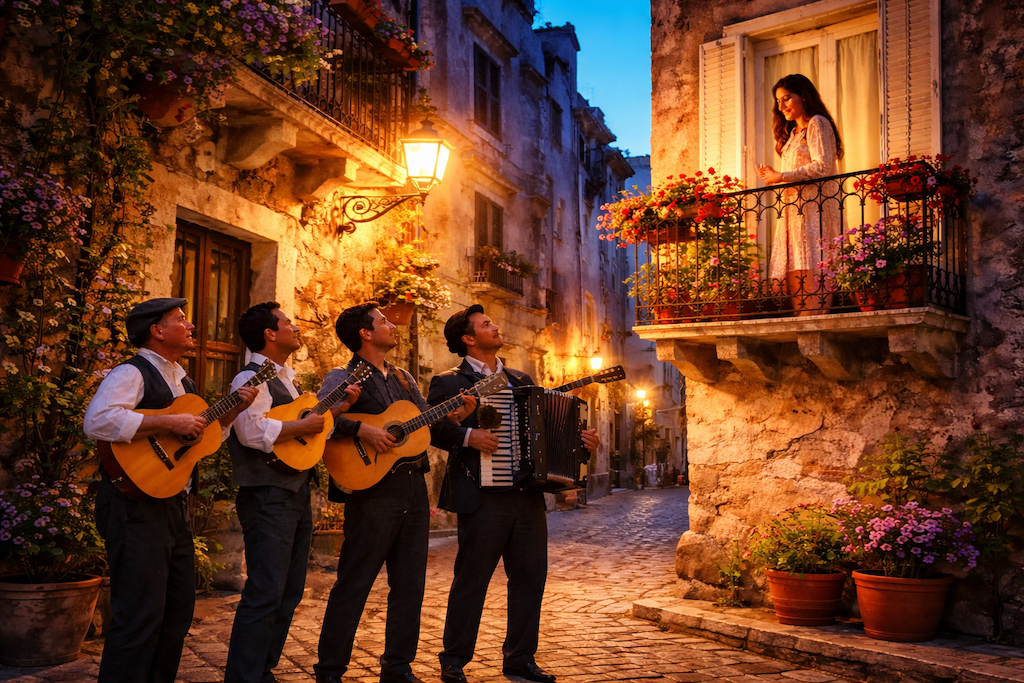

Traditional Greek serenades reveal tradition’s wealth and history along with the most romantic expression of love under starlit skies.
Once upon a time, love had a voice that floated through the night air. It didn’t hide behind screens, vanish in fleeting notifications, or shrink to a short message. Love was sung softly, deliberately, beneath a balcony. In Greece, the kantada was for decades the most authentic, almost sacred, expression of passion: a musical confession to the open sky, witnessed only by narrow cobbled streets, the warm glow of lamplight, and the hush of a sleeping city.

Today, traditional Greek serenades live mostly in memory, in the golden frames of old films, in the stories told by those, who once heard it. Yet, their history whispers something deeper: a culture that knew how to pause, to listen, to truly feel.
From Cantare to Greek balconies
“Kantada” derives from the Latin cantare—“to sing.” In Greece, it was not born as a folk song but as an urban tradition, enriched by Western European influences, especially Italy. On the Ionian Islands, under centuries of Venetian rule, a distinctive musical language emerged, blending polyphony, bel canto, and the Greek tongue.
After the union of the Ionian Islands with Greece in 1863, traditional Greek serenades traveled to the mainland. In late-19th-century Athens, a city awakening to its urban identity, the kantada found a perfect stage: the narrow lanes of Plaka, neoclassical townhouses, and the slow, moonlit promenades of the evening.

Ionian vs. Athenian Serenades
The Ionian serenade was essentially polyphonic. Male voices, often in choirs, sang with both discipline and emotion. In Zakynthos and Corfu, the kantada was more than a romantic gesture; it was a social event, woven into the fabric of daily life.
The Athenian version, by contrast, was freer, more spontaneous. It became entwined with the city’s romance: a young man, flanked by friends and musicians, singing beneath his beloved’s window, a vision later immortalized on the silver screen.
Instruments that whisper love
No orchestra was needed. The traditional Greek serenades thrived with simple, portable instruments, capable of filling a street with gentle music. The guitar laid the foundation; the mandolin, particularly in the Ionian Islands, lent a bright, lyrical voice. In some areas, the mandola deepened the sound, and in the 20th century, the accordion added warmth and resonance.
But above all were the voices: duets or trios, led by a first tenor with others weaving intricate harmonies. The music was intimate, meant for the right balcony, not the whole neighborhood.
Cantadores: Lovers or Professionals?
As old Greek films show, traditional Greek serenades weren’t always spontaneous. In cities like Athens, Patras, Corfu, and Zakynthos, professional or semi-professional cantadores could be hired. The admirer chose the song and key, paid the musicians, and sometimes added flowers or a handwritten note.

Did you know?
Many classic cinematic serenades were staged: the actors often lip-synced to professional voices. Yet the instruments, the ensembles, the very streetscapes—they were real. Cinema did not invent the kantada; it preserved it, giving it a kind of immortality.
Words that whispered in the night
Ionian serenades favored simplicity. Their lyrics were everyday and understated, yet brimming with emotion:
Corfu — Traditional Serenade (anonymous)
Open, open my love,
open so you can see me,
for in the night outside
I stand singing for you.
Zakynthos — Arekía (old Ionian form)
Beneath your window
the night takes me whole,
yet if you appear
I forget all my pain.
Kefalonia — Traditional Serenade
The moon rises again
and speaks to me of you,
and my heart cannot bear
a single night apart.
Editorial note: These songs were never meant for paper but were crafted to be heard once, at the precise moment.
Why the serenade still touches us
Because it required presence, courage, and patience. It couldn’t hide behind a screen. It declared itself boldly, tenderly. Perhaps that is why today, the kantada feels so fresh not as a quaint custom, but as an idea, timeless and alive.
An invitation to old-fashioned romance
This Valentine’s Day, instead of a hurried message or heart emoji, try something different: a song. Whisper it, falter if you must, but make it real.
For in Greece, once upon a time, the greatest love stories began this way: with a serenade, beneath a balcony, in the soft hush of night.

