
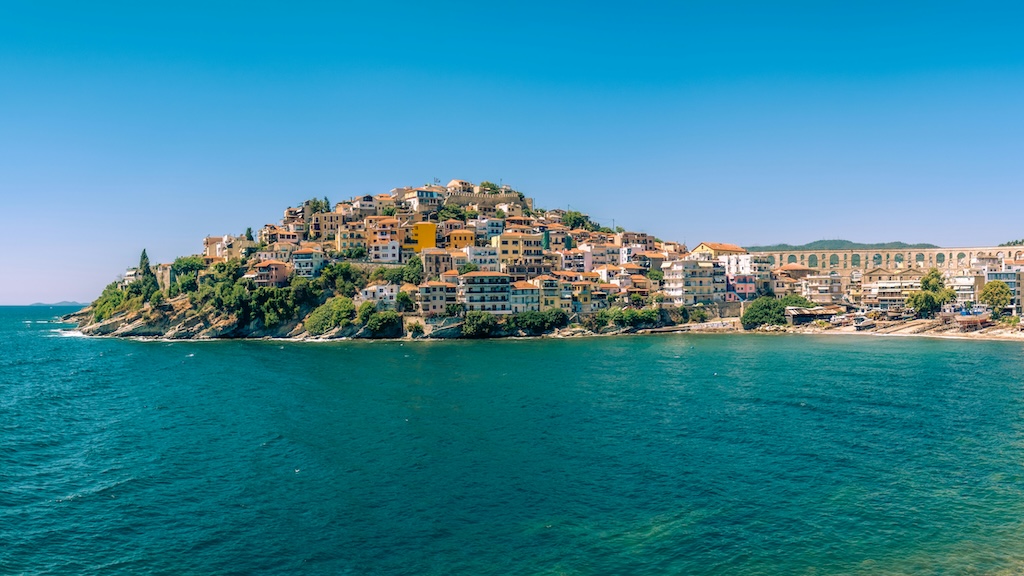

Kavala in spring: timeless history, sparkling Aegean shores and refreshing sea breezes. Uncover the elegance of this coastal gem.
The city in its most poised moment
Some destinations peak under the blaze of August. Others reveal their true character in the quiet shift between seasons. Kavala belongs firmly to the latter.
In spring, before high season reshapes its rhythm, the city settles into a rare balance. Cafés stretch gently toward the waterfront, the cobbled lanes of Panagia glow in soft light, and the horizon line toward Thasos feels almost private. The Aegean is calmer, clearer, less spectacle, more presence.
Built amphitheatrically along the slopes of Mount Symvolo, Kavala stands on the site of ancient Neapolis, founded by Thasian colonists in the 7th century BC. Later integrated into the Roman Via Egnatia, the city became the first European soil stepped upon by the Apostle Paul in 49 AD. Here, history is not hidden underground — it unfolds in the topography, in the curves of the streets, in the shifting color of stone as the sun rises.

Panagia and the view from the Walls
The old quarter of Panagia preserves Kavala’s most authentic cadence. Ottoman-era houses with wooden projections lean over narrow alleys; courtyards bloom with jasmine and basil; stone stairways lead to unexpected vistas.
At the summit, the Kavala Fortress crowns the peninsula. Fortified in Byzantine times and reshaped in the 15th century, it offers one of the most expansive panoramas in northern Greece. From here, the city appears almost theatrical: the aqueduct’s arches, tobacco warehouses, the harbor, and beyond them, the island silhouette of Thasos.
Just below stands the Imaret of Kavala, founded in 1817 by Muhammad Ali of Egypt, who was born in Kavala in 1769. Originally a religious and charitable complex, it remains one of the most significant surviving Ottoman monuments in Greece. In spring, its domes and inner courtyards are illuminated in a way that feels almost cinematic, restrained, golden, contemplative.

The Aqueduct and the Tobacco legacy
The monumental Kamares Aqueduct, locally known simply as “Kamares” , defines the city’s skyline. Built in the 16th century atop earlier Byzantine foundations, it once secured Kavala’s water supply. Today, its sweeping arches function as a stone signature at the threshold of the old town, particularly striking in the clarity of spring light.
From the late 19th century onward, Kavala emerged as a major international tobacco processing and export center. Grand tobacco warehouses still stand across the city center, silent witnesses to a period when European companies operated here and the port connected Northern Greece to Mediterranean trade routes.
Cultural venues such as the Municipal Tobacco Warehouse of Kavala and the Tobacco Museum of Kavala preserve this chapter with depth and nuance. They offer more than heritage displays; they provide context to the city’s cosmopolitan past.
Philippi: Antiquity in full bloom
A short drive inland lies the Archaeological Site of Philippi, a UNESCO World Heritage Site set within an open plain. Founded in 356 BC by Philip II of Macedon, Philippi evolved into a significant administrative and early Christian center. The decisive Roman battle of 42 BC took place here, and later monumental basilicas marked its spiritual prominence.

In spring, the site feels especially atmospheric. Wildflowers emerge between ancient stones, the theater overlooks green expanses, and the entire landscape softens into a quiet dialogue between ruin and renewal. It is less about sightseeing and more about immersion.
Sea light and the illusion of an island
Though firmly on the mainland, Kavala carries an unmistakable island sensibility. The waterfront promenade, from Rapsani to Kalamitsa, invites unhurried walks beside the Thracian Sea. Without the density of summer crowds, the city breathes differently.
Spring light lends the water remarkable clarity. Ferries glide toward Thasos at a measured pace, a subtle reminder of geographic proximity and maritime identity. The salt in the air feels clean, almost mineral.

The Hinterland and Mount Pangaion
Kavala’s surrounding landscape completes its narrative. The village of Palia Kavala, with its waterfalls and plane trees, offers gentle hiking routes ideal for mild spring days. Nearby, Akrovouni Kavala and the settlements along the slopes of Mount Pangaion reveal a different dimension of the region.
Known in antiquity for its gold and silver mines, Mount Pangaion now signifies a quieter wealth — vineyards, crisp air, and expansive views across eastern Macedonia. In spring, the vines begin their annual cycle again, adding texture and vitality to the landscape.
What you take home
Kavala leaves subtle impressions. In local ateliers, handcrafted silver jewelry often incorporates Byzantine or Macedonian motifs, understated references to the region’s layered past. Antique shops occasionally display tobacco crates or archival photographs, fragments of a once-global trade network.
Textiles preserved by Asia Minor and Pontic cultural associations reflect the refugee heritage that reshaped the city after 1922. Regional wines, mountain herbs, and traditional almond sweets scented with blossom water extend the experience beyond the visit itself.

The elegance of the in-between season
Kavala in spring does not compete for attention. It does not overwhelm. Instead, it allows space to observe, to wander, to connect.
From Byzantine walls to Ottoman domes, from Roman ruins to vineyard slopes, the narrative here is layered yet coherent. Perhaps that is the privilege of the in-between season: before summer claims it fully, Kavala still belongs to those willing to experience it with intention.

