

Naples leads from colourful Santa Chiara to Litochoro and Mount Olympus, exploring monastery architecture, landscapes and religious heritage.
Naples brought back the memory of a place in Greece that I first discovered through someone else’s stories.
I was about twenty, still a student, when Vangelis Angelis, a fellow student from Litochoro, would often talk about his hometown. Until then, I do not remember knowing very much about it.
My own childhood images were filled with the light of Nafplio, the sea, its neoclassical buildings and castle, along with the distinctive landscape of Leonidio, its red rock, traditional settlement and the Arcadian land descending towards the sea. Litochoro added a different image of Greece. Mount Olympus rising above the town, nature becoming part of its identity and, a little farther away, Leptokarya and the coast of Pieria bringing the sea back into the landscape.
It was the late 1990s. Social media had not yet entered our lives, and places travelled differently then. Through photographs, books and, above all, through the stories of people who knew and loved them.
Without realising it at the time, those conversations began to shape a different travel map of Greece in my mind. Images of places I had never seen and the desire to discover them one day.
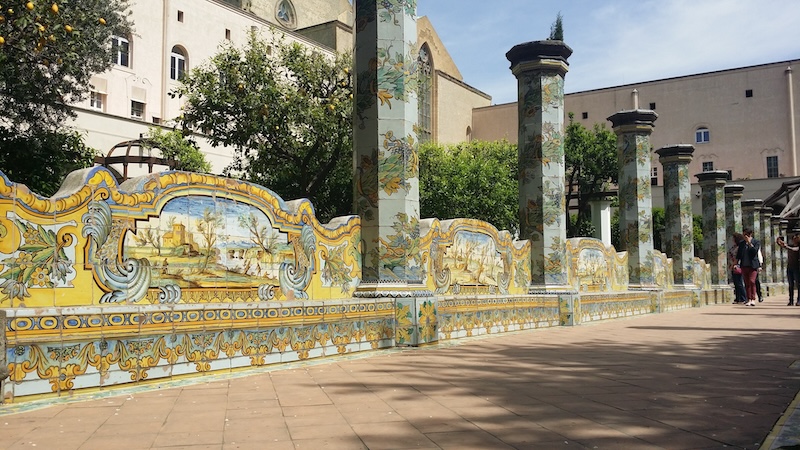
More than twenty five years later, an image from Naples brought those stories back. Santa Chiara, with its colourful cloister, painted majolica, greenery and Mediterranean light, became the starting point for this rather different journey.

This journey is for you too, Vangelis. Many years ago, without knowing it, you showed me the power of talking to others about the place you come from. Of helping them picture it before they have ever been there and giving them a reason to want to travel there one day.
An old story from Litochoro now meets an image from Naples. Our starting point is in the heart of the city, behind the doors of Santa Chiara.

What should you see in Naples?
In the very heart of Naples, Santa Chiara changes the atmosphere of the city within just a few steps. Construction of the monumental complex began in 1310, and once inside, it is the colours of the cloister garden that immediately catch the eye.
The Chiostro Maiolicato is the place to look for. Two paths divide the garden into four sections, lined by 64 octagonal columns covered in colourful majolica tiles. Between them are benches decorated with scenes of everyday life, the countryside, the sea and mythology.

Blue, yellow and green ceramics meet citrus trees and the garden pergola. Under the Naples sun, the colours become even more vivid, while the greenery completes a distinctly Mediterranean scene with the familiar feeling of a Greek summer.
Why is Santa Chiara so special?
The cloister took on its present form in the 18th century, following the design of Domenico Antonio Vaccaro, while its colourful majolica decoration was created by Neapolitan ceramic artisans Donato and Giuseppe Massa.
A closer look at the painted surfaces reveals small stories. Among the maritime, rural and mythological scenes is one particularly charming detail. A Poor Clare nun is shown feeding the monastery cats. It is the only scene on the ceramic benches depicting life within the monastery, offering a small glimpse into the everyday world of the people who once lived here.

Santa Chiara was originally created with two separate monasteries, one for the Poor Clares and another for Franciscan friars. Today, the complex also houses a museum, while its archaeological area preserves sections of Roman baths dating from the 1st century AD.
From this Mediterranean setting, our story returns to Greece and the foothills of Mount Olympus.
Which monastery should you visit on Mount Olympus?
Litochoro is the starting point for discovering the Enipeas Gorge and the natural landscape of Mount Olympus. Surrounded by the greenery of the gorge stands the Old Monastery of Saint Dionysios, built in the 16th century at an altitude of approximately 850 metres and around 17 kilometres from Litochoro.

The monastery suffered damage during the Greek War of Independence in 1821 and was destroyed again by German forces during the Second World War. Restoration and conservation work later followed to preserve the historic complex.
Here, the relationship between architecture and landscape is worth observing. The stone monastery becomes part of its surroundings, set among forest, the slopes of Mount Olympus and the waters of the Enipeas. The Cave of Saint Dionysios can also be found in the area.
A visit to the monastery can easily be combined with the Enipeas Gorge, Mount Olympus and Litochoro, creating a journey through the nature, history and religious heritage of the region.
What should you see in Litochoro?
Litochoro is one of the main gateways to Mount Olympus and the routes leading towards the Enipeas Gorge. The mountain dominates the landscape and is a constant presence above the town.
From Litochoro, it is also worth heading towards Leptokarya and the coast of Pieria. Within a relatively short distance, the mountain landscape of Olympus meets the sea, revealing two very different sides of the region.

This was the image that had begun to form in my mind through those old stories. Mount Olympus on one side and the sea on the other.
Why do monasteries become part of a journey through Greece?
Greece is home to monasteries and religious monuments that hold particular interest for their architecture, art, history and relationship with the natural landscape. They are also part of religious tourism in Greece, an experience that can connect mountain destinations, historic settlements, hiking and places close to the sea.
The Monastery of Saint Dionysios on Mount Olympus is a characteristic example, as a visit here fits naturally into discovering the mountain, the Enipeas Gorge and Litochoro.

Santa Chiara in Naples was the inspiration for this story. Its colourful majolica led us into a monastery garden, and from there an old memory brought us back to Litochoro, Mount Olympus and the coast of Pieria.
That is one of the most beautiful things about travel. An image can remind us of a place, a place of a person, and an old story can open the way to the next journey.
Is there a place you first discovered through someone else’s words and later wanted to visit for yourself? Share your story with us. It could become the inspiration for the next travel story on Hospitality Ambassadeurs.

