
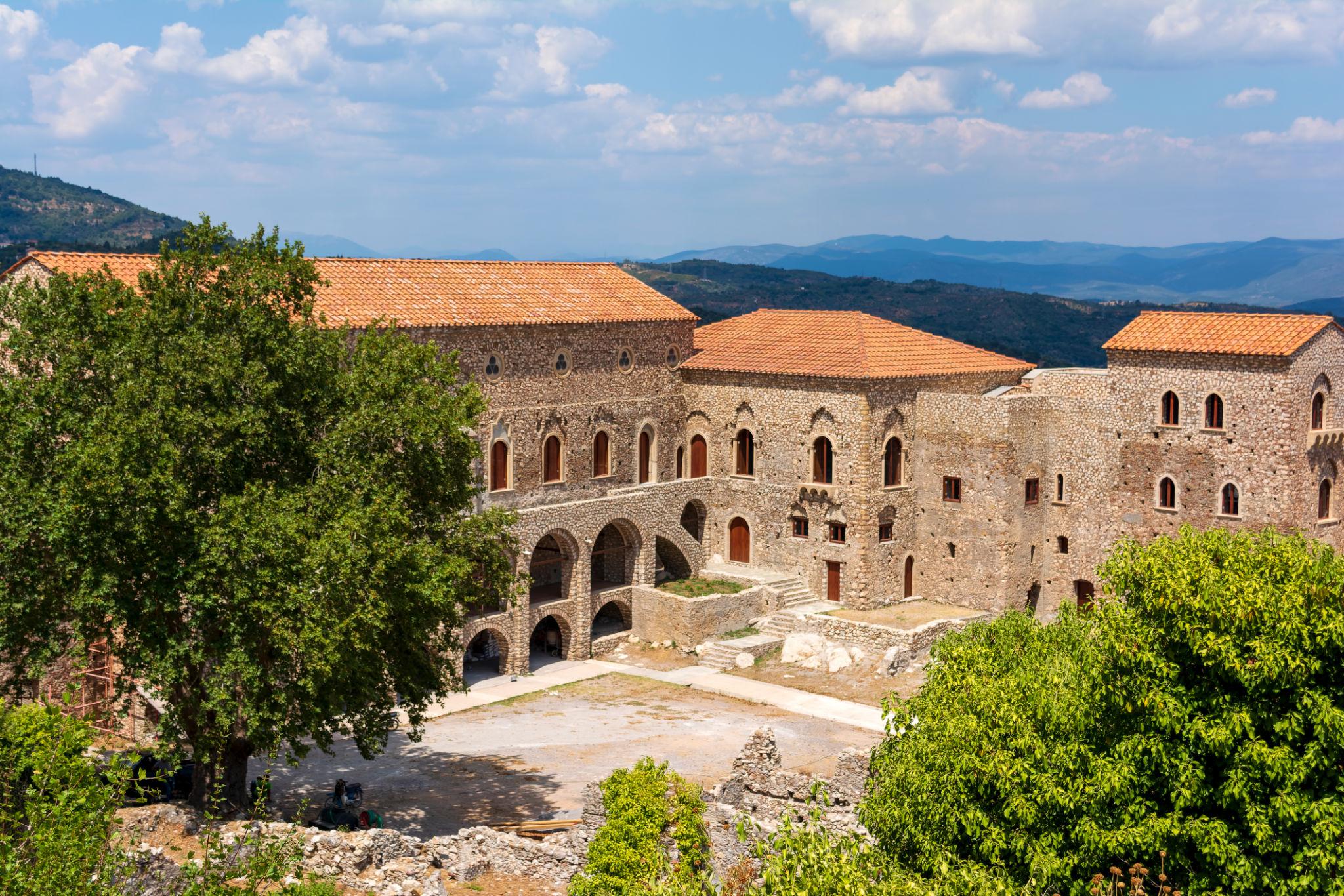

Palace of the Despots in Mystras combines Byzantine history and the landscapes of the Peloponnese in a unique journey through time.
A journey into the Byzantine world of Mystras
At the foot of Mount Taygetus, just a few kilometers outside Sparta, stands Mystras, a living reminder of the last great era of the Byzantine Empire. This fortified Byzantine town in Laconia is one of Greece’s most important historical destinations, transporting visitors to the final centuries of Byzantium, in a setting where time seems to have stopped.
Μystras is filled with cobbled streets, churches, monasteries, and ruined aristocratic mansions that create an atmosphere of mystery and authenticity. Every corner reveals a different layer of history.
At the heart of this unique city, where history meets power and architecture becomes storytelling, stands the Palace of the Despots , the most emblematic and important monument of Mystras. Built in a commanding position overlooking the Laconian plain, it reflects the story of a city that once served as a political, cultural, and spiritual center of the entire Peloponnese.

The history of the fortified city of Mystras
The history of Mystras begins in 1249, when the Frankish ruler William II of Villehardouin ordered the construction of a castle on the hilltop overlooking the Sparta valley. From that moment, the hill gained strategic importance and gradually evolved into one of the most influential places in the Peloponnese.
Its strategic position allowed control over the Sparta valley, and soon a settlement developed around the fortress, becoming a structured and thriving city rather than just a military stronghold.
A few years later, Mystras passed into Byzantine hands and became the capital of the Despotate of the Morea. During the 14th and 15th centuries, it reached its peak, emerging as one of the most important intellectual and cultural centers of the empire, home to scholars, artists, and aristocrats.
The philosopher George Gemistos Plethon, one of the most iconic figures of the late Byzantine period, lived here and significantly shaped the intellectual identity of the city.
Mystras remained a major administrative center until the Ottoman conquest in 1460. Today, it is a UNESCO World Heritage Site and one of the most important archaeological destinations in Greece.

The Palace of the Despots and the glory of Byzantine Morea
The Palace of the Despots is the most iconic monument of the fortified city and the only surviving Byzantine palace complex in Greece, a place where history is literally written in stone. From here, the entire Morea was governed, and key political decisions for Byzantine Peloponnese were made.
Its architecture blends Byzantine and Frankish influences, reflecting the long and complex history of the region. Large halls, open spaces, and sweeping views over Sparta create an imposing image, as if the building itself still moves through time.
In recent years, major restoration works have been completed, fully restoring the Palace of the Despots and making it accessible to the public. New exhibition installations turn the visit into an immersive experience that brings visitors closer to the world of late Byzantium.

What you will discover inside the Palace
Entering the Palace of the Despots reveals a world filled with history and scenes from the life of the last Byzantine rulers. Restored halls and exhibition spaces help visitors imagine how the despots of Mystras lived and how the Despotate of the Morea functioned.
One of the most impressive spaces is the Throne Hall, where elements of the Byzantine court and imperial authority are presented in a setting that still preserves its grandeur. The atmosphere evokes the era of the Palaiologos dynasty, the last emperors of Byzantium, closely linked with Mystras.
The permanent exhibition “Princely Narratives” showcases the history of the palace and the role of imperial families in governing and shaping the intellectual life of the fortified city. Through digital installations and modern museum techniques, visitors follow the evolution of Mystras from Frankish rule to the final years of the Byzantine Empire.
Of special interest is also the exhibition “Reflection of Glorious Attire”, focusing on Byzantine court clothing. It presents reconstructions of imperial garments, official regalia, and symbols of authority, revealing how clothing functioned as a marker of power and identity in Byzantine society.
The visit ends with breathtaking views over Sparta and the Laconian plain, a landscape that connects past and present, seen exactly as it was centuries ago by the rulers of Mystras.

The most important sights of Mystras
Exploring Mystras reveals countless landmarks, each with its own story. The Church of Saint Demetrius is one of the most important monuments and is linked to the coronation of the last Byzantine emperor, Constantine Palaiologos.
The Monastery of Pantanassa stands out for its architecture and remains active as a convent to this day, preserving the spiritual tradition of the region. The Monastery of Peribleptos is famous for its stunning frescoes, while the Church of Hagia Sophia offers panoramic views over the Laconian plain.

Walking along the cobbled paths of the hill is an unforgettable experience, where movement becomes part of the landscape. The natural beauty of Mount Taygetus, stone towers, and ruins of old homes create an authentic and atmospheric setting in every season.
Local flavors and products you must try
A trip to Mystras is also a journey into the gastronomy of Laconia, where nature and tradition meet in every taste. The region is famous for its high-quality olive oil, olives, oranges, and aromatic local products.
In the tavernas and small eateries around Mystras and Sparta, visitors can enjoy traditional Peloponnesian dishes made with local ingredients. Smoked pork (syglino), handmade pasta, herb pies from Taygetus, and desserts with honey and orange are among the region’s signature flavors.
Local wines from vineyards around Sparta complete the culinary experience, pairing perfectly with Mediterranean cuisine and enriching the cultural journey through the Peloponnese.
Best time to visit Mystras
Spring and autumn are the ideal seasons to visit Mystras, when light and temperature highlight the landscape at its best. Mild weather makes exploring the hill much more comfortable and enjoyable.
In spring, the area bursts with colors and aromas, while autumn gives the fortified city a calm, atmospheric character that enhances its historical aura.
In summer, temperatures in Laconia can be high, so early morning visits are recommended. Winter offers a more mystical experience, with mist often surrounding the Byzantine monuments and Mount Taygetus.
Opening hours and tickets
The archaeological site of Mystras is open daily. During the summer season (April to October), opening hours are 08:00–20:00. In winter (November to March), it is open from 08:30–15:30.
The general ticket for the archaeological site and museum of Mystras costs €20, with reduced and free admission available for eligible visitors.
How to get to Mystras
Mystras is located about 6 km from Sparta and is easily accessible by car. From Athens, the drive takes around three hours via the Corinth–Tripoli–Sparta highway.
For those traveling without a car, daily KTEL buses run to Sparta, followed by a local connection to Mystras. The site has both an upper and lower entrance, with many visitors preferring the upper entrance for a more comfortable, downhill route.
Why the Palace of the Despots is a once-in-a-lifetime experience
The Palace of the Despots is one of the most significant historical destinations in Greece and one of the most fascinating journeys into the world of Byzantium. Its history, architecture, exhibitions, and unique atmosphere create an unforgettable experience.
Mystras combines the power of history with the natural beauty of the Peloponnese. From the Palace of the Despots to the monasteries and cobbled streets, every part of the site reveals images from the final chapters of the Byzantine Empire.

