
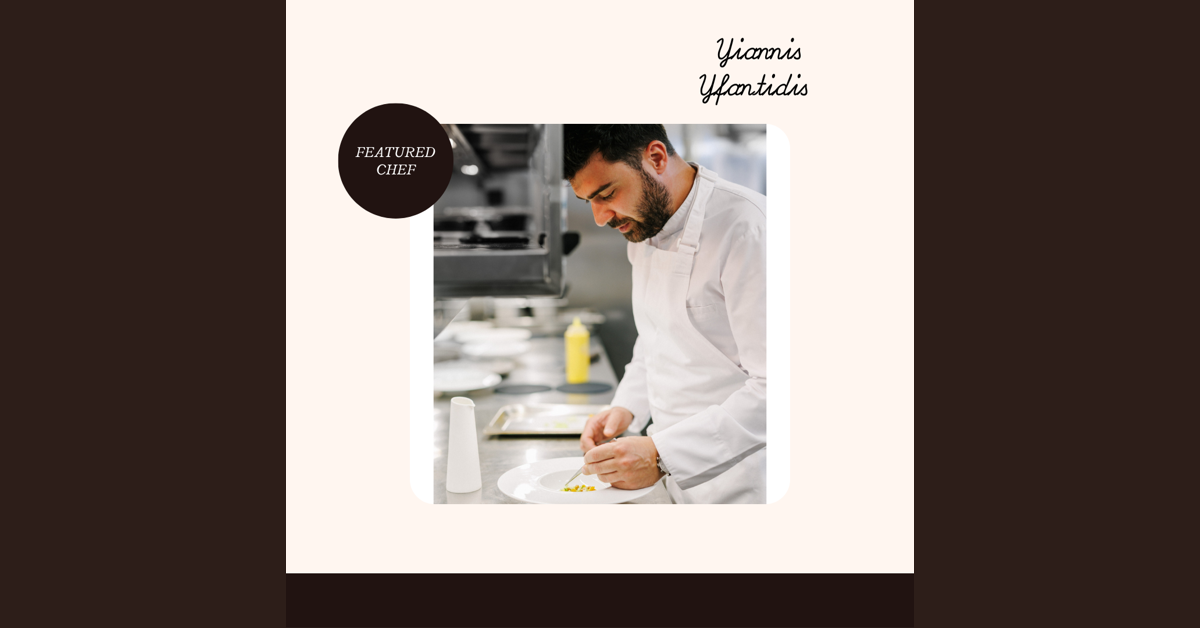

Υiannis Yfantidis leads Varoulko with creativity, honoring tradition while redefining modern Greek seafood cuisine.
«In Mikrolimano, where the waves touch Varoulko, a new creative voice emerges in the kitchen. Yiannis Yfantidis grew up cooking at Varoulko—a restaurant that, since 1985, has set new standards in seafood gastronomy and is known for innovations such as a modern Greek approach to classic fish and seafood dishes—and expanded his training alongside top chefs like Alain Ducasse in Paris and in Saint Moritz. After 12 years of continuous learning and creation, he has now taken the reins as Head Chef, ready to bring fresh ideas while honoring the restaurant’s tradition and history.»

«He dislikes seeing ingredients sacrificed for the sake of show. Every dish has the power to showcase its unique qualities, as long as it is made with a pure heart and genuine love. For him, every ingredient has a voice, every season holds its own magic, and every dish is a piece of his personal journey. Cooking is a continuous journey of knowledge that continues at Varoulko, opening paths for new creations and experiences.»
H.A: If you had to cook just one dish to introduce Greece to a foreign chef, what would it be and why?
I would suggest oven-baked fish plaki. It’s a dish you’ll encounter in many variations, in homes from the Aegean to Macedonia, with family gathered around the table. It carries with it all the wisdom of Greek culinary tradition. Fresh fish, tomatoes, onions, olive oil, and herbs come together in a way that reflects the simplicity, purity of flavor, and respect for raw ingredients that characterize Greek cuisine.
H.A: Comfort food and haute cuisine: where do they meet for you? Could a “humble” kakavia be part of a degustation menu?
For me, comfort food and haute cuisine are inextricably linked. Comfort food is the foundation for everything else because it connects to the tastes and aromas of our childhood, to food that creates warmth and coziness. No matter how flawless the technical execution of contemporary haute gastronomy, it will fail if it cuts itself off from that background. I believe the meeting point of the two worlds is the moment, when technique manages to serve memory.
As for kakavia, it is a dish with a clear identity and deep flavor, which not only can but should be included in a degustation menu. It can be presented with different techniques and variations, without interfering with its “soul,” which is the authentic taste of its broth.
H.A: How do you imagine Varoulko in the next ten years? And yourself within this journey?
Varoulko is a landmark restaurant for Greece because it managed to change the way we perceive seafood cuisine. In the next 10 years, I would like to continue to see it evolve and innovate, without betraying its values and identity. Its focus on hospitality, respect for ingredients, seasonality, and the quality that has always characterized Varoulko is the most solid foundation for a creative dialogue with the new era. As for myself, I want to keep learning, evolving, and serving the vision that Lefteris Lazarou began, leading it further with respect and creativity.

H.A: If your culinary journey so far were a trip with stops along the way, which moment would you mark as a “station” and why?
Undoubtedly, the milestone in my culinary journey was when I took on the role of sous chef at Varoulko. That was the moment of an inner transition because I began to think not only about how to cook better but also about how to help the team grow as a whole. My responsibility extended beyond the quality of the dish, into managing people and maintaining balance in a high-pressure, detail-oriented environment.

H.A: Is there a flavor or aroma from childhood that you still seek in the kitchen?
I come from a family with Pontic roots, where cooking was a key part of everyday family life. The smell that follows me from childhood is that of sirva, a traditional Pontic soup made with wheat, mint, and fresh butter. It’s not just the dish itself, but the warmth, the memories, the simplicity, and the unpretentious taste it carries—elements that made me fall in love with cooking and that I always seek in my dishes.
H.A: If fish had a “voice,” what would they say to you when you hold them in the kitchen?
We are fortunate to be surrounded by a sea that generously offers us fish and seafood of exceptional quality. If fish had a voice, I think they would remind us that they are not an inexhaustible resource and would ask us to treat them with respect. They would call us to a more responsible and sustainable way of cooking—for them and for the sea that hosts them.

H.A: If you were asked to create a dish without any ingredients, only with an idea, what would it be?
For me, food, from the simplest everyday meal to the most gastronomic creation, is all about care. If I could create a dish without specific ingredients, I would distill the feeling evoked by the midday aromas from mothers’ and grandmothers’ kitchens. It’s not about what’s in the pot, but about the feeling that someone cares for you and is cooking for you. That’s the feeling I try to create for the people who eat my dishes.
Yiannis Yfantidis enters Varoulko’s kitchen with respect for its history but also a desire for new creation. For him, cooking is a way to express respect for the ingredients and love for the craft. Every dish is a small story, every flavor an invitation to see the sea through his eyes. At Varoulko, where tradition and innovation meet, a new chapter begins—one that promises to write his own story in modern Greek gastronomy.

