
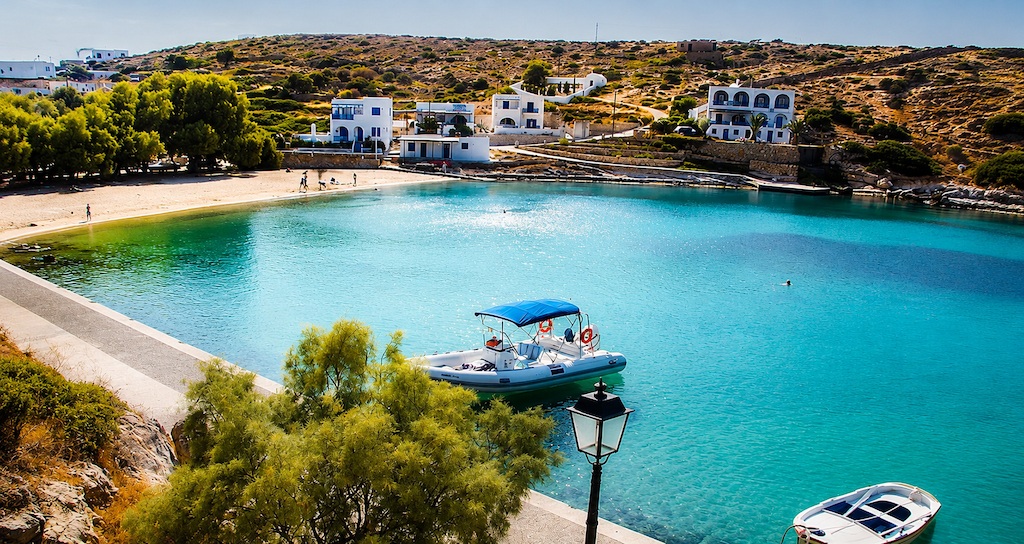

Herakleia is a small Cyclades island known for pristine beaches, hiking routes, local cuisine and a natural landscape in the Aegean sea.
The Cyclades as an archipelago of experiences in the Aegean
The Cyclades form one of the most recognizable island complexes in Greece and the Mediterranean, internationally known for their distinctive Cycladic landscape with whitewashed architecture, blue domes, simple stone structures, and the intense light of the Aegean sea. Their name originates from the circular formation around the sacred island of Delos, which was an important religious and cultural centre of antiquity. In the mythological tradition of the Aegean, the creation of the islands is also linked to Poseidon, who, according to ancient narratives, shaped the sea landscape and geography of the archipelago through the power of the ocean.

Nowadays, the Cyclades are among the most popular destinations in the Mediterranean, with travellers seeking island simplicity, clean beaches, local cuisine, hiking routes, and small settlements that preserve an authentic character. At the same time, islands such as Santorini and Mykonos have evolved into international symbols of the Greek summer, while the smaller islands maintain a more experiential travel identity.

A small island within the greater geography of the Cyclades
Within this archipelago, Herakleia is located in the cluster of the Small Cyclades, between Naxos and Ios, in a maritime zone that connects islands such as Schoinousa, Koufonisia, and Donoussa. The island covers approximately 18 square kilometres, with very low building density, and its settlements are mainly concentrated in Agios Georgios and the small inland village of Panagia.
The landscape consists of low hills, dry-stone walls, aromatic scrub vegetation, and small valleys that gently descend toward the sea, while the coastline embraces the island on every side.
Historical depth, trails, and natural identity of the Small Cyclades
Herakleia is not only a serene island of the Small Cyclades but also a place with deeper historical continuity. Archaeological findings indicate habitation as early as the Neolithic and Early Cycladic periods, placing the island within the earliest settlement networks of the Aegean.
In the broader narrative of Homeric tradition in the Aegean, the figure of the Cyclops is also included, with the Cave of Saint John being locally associated with stories of earlier use as a shelter or a site of special significance, creating a sense of mythological continuity in the landscape.
Herakleia is also an island defined by its connection to the sea and the ferry routes of the Small Cyclades. Agios Georgios functions not only as a settlement but also as a key maritime transport hub connecting Naxos, Amorgos, Schoinousa, and Koufonisia, directly influencing the island’s rhythm of life and daily routine.
It is one of the most distinctive islands for hiking in the Cyclades. Its trails connect Agios Georgios with Panagia, lead toward the cave, and continue to elevated viewpoints overlooking Naxos, Ios, and Amorgos. The island functions as a natural slow-travel landscape, where the experience is not the movement itself but the journey.
It is part of the Natura 2000 network, mainly due to its marine biodiversity and the presence of migratory bird species. Its environment remains largely untouched, with minimal human intervention, which explains the absence of intensive tourism development. This shapes the island’s overall identity as a destination of mild and authentic tourism.

Summers, beaches, and a life flowing beside the waves
In Herakleia, summers are expressed through everyday scenes that unfold almost ritualistically. Family gatherings, sea from morning to evening, and stories passed down through generations create an experience rooted in continuity. The island’s memory is connected to a simpler life, moving with light and nature, while local products such as goat meat, local cheeses, legumes, and thyme honey produced from the aromatic Cycladic land are part of this daily life.

Livadi, the island’s largest beach, stretches with an open horizon and clear waters, while smaller coves and swimming spots appear along the coastline and are accessible either by trails or small boats. The sea around Heraklia is clear and calm, reflecting the character of the Small Cyclades.
Beyond the well-known beaches, the island’s coastline reveals a more hidden geography. Agios Georgios beach, next to the port, serves as the island’s everyday swimming spot, with sandy shores and calm waters.
The small cove of Tourkopigado, a secluded pebble beach with clear waters on the southern side of Herakleia, offers peace and relaxation.
On the northern side, Alimia stands out for its crystal-clear waters, while the wreck of a World War II aircraft on its seabed has turned it into one of the most interesting underwater exploration sites.
On the western side, the small bay of Karvounolakos remains difficult to access and almost untouched.
At the same time, small, almost unknown coves are found where trails meet the sea, mainly on the eastern and southeastern sides of the island.
Within this landscape, beaches do not function as isolated points but as a unified experience of the land and sea, where the ocean becomes part of the island’s daily movement.
A Cycladic cuisine with a subtle character
The gastronomy of Herakleia is based on simple raw ingredients. Local products, fresh fish, goat meat, legumes, and aromatic herbs shape a cuisine focused on naturalness and purity of flavours.
During the summer months, the restaurant Araklia – Araklia Authentic Aegean Cuisine by Yiannis Gavalas operates on the island, a space that connects family memory with contemporary Cycladic cuisine. Overlooking the small Cycladic archipelago of Schoinousa, Keros, Koufonisia, and Amorgos, and making use of his family home, Yiannis Gavalas brought a lifelong dream to life, transforming it into a fully functioning open space, with Araklia offering since 2019 memories of authentic Aegean cuisine.

Around this core, the island’s gastronomic scene is complemented by small eateries in Agios Georgios and Panagia, such as Syrma by the port serving fresh fish and seafood meze, Akathi with daily island cuisine based on local products, Perasma as an all-day café and light meals spot near the port, To Steki in Panagia with home-cooked recipes and traditional dishes, Ypovrychio with a seaside atmosphere focused on fresh seafood and simple Cycladic flavors, and Askos, known for its relaxed setting and contemporary approach to traditional island cuisine. Together, these spaces form a gastronomic identity based on a small-scale, family-oriented character, seasonality, and personal connection to place.
Small accommodation units within the Cycladic landscape
Herakleia maintains small-scale accommodation that faithfully follows the island’s character. In Agios Georgios, Speires Suites offers suites and terraces overlooking the Aegean and the harbour, Maistrali Rooms provides seaside accommodation closely tied to the settlement, while Angelos Rooms and Gialiris Rooms operate as family-run guesthouses.
Sohoro Studios are set in a natural environment with olive trees and vineyards near Agios Georgios beach, while Villa Panorama is located in an elevated position with views over the surrounding islands and easy access to both the settlement and the sea.
Herakleia follows a steady rhythm of life, intertwined with light, the sea, and daily island existence. Experiences on the island are based on simplicity and an idyllic landscape that preserves its authentic character.

