
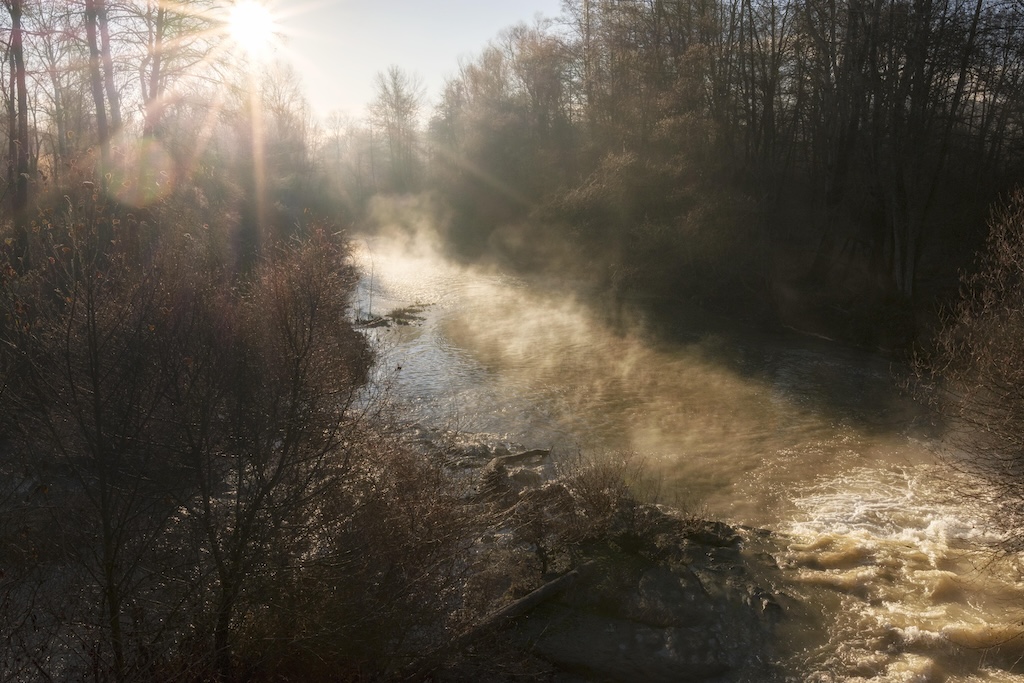

Imathia unfolds from the forests of Vermio to the Aliakmonas Gorge, through mountain villages, vineyards and the royal past of Vergina.
It all began with a curious story about a tiny train hidden in the forest. Looking for it took us to Vermio, and the journey followed its natural course.
The road led us through mountain villages and slopes filled with wild herbs, to the Gardens of Midas described by Herodotus and the vineyards of Xinomavro. In Vergina, we stopped at the royal tombs before heading towards the Aliakmonas Gorge.
This was the route that drew us to Imathia and carried us from high to low, from the slopes of Vermio to the banks of the Aliakmonas.

Climbing into the mountain villages of Vermio
As we gain altitude, the villages become natural stops along the route. Koumaria, Xirolivado, Seli, Arkochori and Rodochori sit among forests, mountain slopes and plateaus. Across the wider Vermio area, beech, oak and chestnut woods alternate with meadows, springs, streams and small waterfalls.
Xirolivado spreads across a plateau at 1,220 metres, with a small lake known locally as Bara beside the village. Arkochori, a few kilometres from Naoussa, is officially designated as a traditional settlement. Around Seli and Xirolivado, Vermio opens into forests, clearings and broad mountain expanses.
Koumaria was formerly known as Doliani, and its history is closely linked to the Vlach communities of Vermio. In the mountain villages, Vlach traditions live on through festivals and dances, along with memories of a pastoral way of life shaped by the mountain grazing lands. Xirolivado also has customs with intriguing names such as Perperouna and Galeata, traditionally associated with rituals calling for rain.
To experience this side of Imathia, choose two or three villages and leave time for small detours. Vermio has more than 70 kilometres of marked hiking and mountain-biking trails. We head into the forest in search of the Decauville that first brought us to Vermio.
Following the Decauville railway through the forests of Vermio
Around 10 kilometres from Naoussa, at Gournosovo and an altitude of approximately 1,050 metres, a timber mill operated about a century ago. A Decauville train carried logs from the forests of Vermio to the sawmill.
Today, you can walk for around three kilometres along the route once followed by the railway line. In the middle of the forest, it is almost cinematic to imagine an industrial train making its way through the trees, laden with timber.
The Decauville opens a window onto a lesser-known chapter in Vermio’s history. For the mountain communities, the forest was closely tied to logging and timber processing. Walking the train’s route today means following a fragment of Imathia’s industrial past.

The Decauville railway in the forests of Vermio, loaded with timber
Photographic archive of Takis Mpaitsis
Discovering Vermio’s wild herbs and Midas’ sixty-petalled roses
In Vermio, it is worth looking down, quite literally beneath your feet. Its flora includes hundreds of species of wildflowers and medicinal herbs, among them peonies, wild carnations and red lilies.
Greek mountain tea is one of the plants closely associated with Vermio and is traditionally gathered in July. Mushrooms also have their place in the local cuisine. In the mountain villages, knowledge of what the land provides follows the seasons and is passed down from one generation to the next.
The area’s relationship with plants reaches far back in time. Herodotus placed the famous Gardens of Midas at the foot of Vermio and described wild roses with sixty petals and an exceptional fragrance.
In spring, his account easily comes to mind as the slopes of Vermio fill with wildflowers and herbs.
Descending from Vermio into the fertile plains of Imathia
As we descend, the landscape changes quickly. The fertile plain of Imathia opens ahead, a major growing area for peaches, cherries, apples, kiwis, grapes and vegetables.
On the way down from Vermio towards the plain, Naoussa is worth a short stop. The Arapitsa river runs through the town, while a few kilometres away, at Agios Nikolaos Park, its springs flow among centuries-old plane trees.
Around Naoussa, the vine takes centre stage. The PDO Naoussa wine zone was established in 1971, and its red wines are made exclusively from Xinomavro. Most vineyards spread across the southeastern slopes of Vermio at elevations of around 150 to 400 metres.

Xinomavro is a red grape variety known for its high acidity, pronounced tannins and excellent ageing potential. For a short wine stop, visit Ktima Kir-Yianni in Yiannakohori or Argatia Winery in Rodochori, two wineries along the wider route.

Tasting Imathia, from quince-cooked lamb to Xinomavro
At a taverna in Imathia, the flavours of the region arrive one by one. Pies, Batzos PDO cheese, mushrooms and a glass of Xinomavro. Imathia’s cuisine carries Vlach, Pontic Greek and Asia Minor influences, making generous use of what the mountain and the plain provide.
One dish that makes us pause is zygouri me kydoni, hogget cooked with quince. If you find it on the menu, it is worth trying. Other local dishes include fasoulontavas, a slow-baked bean dish, and sarmadakia with mushrooms, while savoury pies remain a constant presence in the local kitchen.
Imathia’s abundant fruit production also finds its way into the region’s gastronomy. Peaches, apricots and other fruits from the plain are preserved in jars as spoon sweets and jams. A glass of Xinomavro draws another connection between the fertile plain and the vineyards on the slopes of Vermio.
Stepping into Macedonia’s royal past at Vergina
In Vergina, the landscape gives way to the royal past of ancient Macedonia. This is where Aigai stands, the first royal capital of the ancient kingdom of Macedonia and a UNESCO World Heritage Site since 1996.

The archaeological site includes the monumental palace, theatre, sanctuaries and royal necropolis with hundreds of burial mounds. Among the royal tombs is the unlooted tomb identified as that of Philip II, father of Alexander the Great.
Vergina offers a vivid encounter with the past, before the route turns towards the Aliakmonas.
Tracing centuries of monastic life along the Aliakmonas
Approaching the Aliakmonas brings another, lesser-known layer of Imathia into view. The Holy Skete of Veria developed on the slopes around the river, a monastic community whose history reaches back to Byzantine times.

The Monastery of Timios Prodromos stands in the green foothills of the Pierian Mountains, overlooking the Aliakmonas. The present monastery dates to the 14th century, on a site where an organised skete had already existed in the 9th and 10th centuries. Gregory Palamas also spent a period of his ascetic life in the region.
The Monastery of Panagia Kallipetra belongs to the same monastic landscape, on the slopes of Vermio beside the Aliakmonas, with historical references dating back to the 11th century. The route follows the river towards the Aliakmonas Gorge.
Birdwatching in the Aliakmonas Gorge
At the Aliakmonas Gorge, the river runs between oak forests, rocky slopes and dense riverside vegetation. The area forms part of the European Natura 2000 network and is an important habitat for wildlife.
We stop for a moment and look up. More than 215 bird species have been recorded across the wider protected area. The Aliakmonas is an important migration corridor, providing feeding, nesting, wintering and refuge sites. Rock partridge, Eurasian eagle-owl, Bonelli’s eagle, short-toed snake eagle and European honey buzzard are among the species recorded here.

For birdwatching, all you need is a little time and a pair of binoculars. For those already hooked, much of the appeal lies in the anticipation of discovery, the kind that can inspire an entire journey.
Along the Aliakmonas, a rare plant once thought extinct
Onobrychis aliacmonia is a rare member of the legume family and a local endemic species of the Aliakmonas. It was discovered on the riverbanks in 1956 and later recognised as a distinct species. The original site where it had been recorded was submerged following the construction of a dam. Subsequent searches came up empty, and the species was considered extinct.
In 1994, it was found again along the riverbanks, where more than 30,000 plants were recorded. A species thought to have disappeared was still growing beside the Aliakmonas. A small story of survival, almost hidden along the riverbank.
What should you see on a trip to Imathia?
Start with the villages and forests of Vermio, walk the Decauville route near Naoussa and descend towards the vineyards, Vergina and the Aliakmonas Gorge. Along the route, visit the Holy Skete of Veria and the old monasteries above the Aliakmonas, in a landscape shaped by centuries of ascetic life.
Which villages in Vermio are worth visiting?
Seli, Xirolivado, Koumaria, Arkochori and Rodochori make ideal stops on a journey through Vermio. Xirolivado stands out for its plateau at 1,220 metres and the small lake known as Bara, while Arkochori lies close to Naoussa and is designated as a traditional settlement. Between the villages, the road runs through forests and open mountain slopes, offering plenty of reasons to pause.
Where can you go birdwatching in Imathia?
The Aliakmonas Gorge is one of the most interesting places for birdwatching in Imathia. More than 215 bird species have been recorded across the wider protected area, many passing through during migration. With a pair of binoculars, every stop along the riverbank comes with the possibility of an unexpected encounter.

