
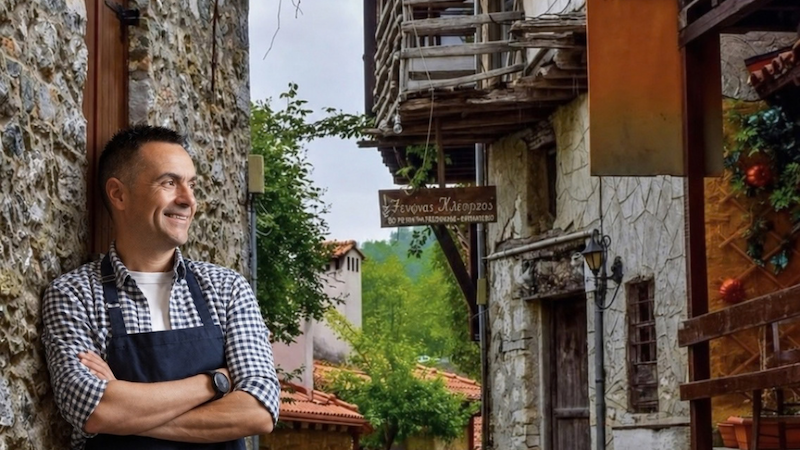

Traditional cuisine of Mount Olympus comes to life through the flavours and food traditions of Palaios Panteleimonas.
The traditional cuisine of Mount Olympus carries flavours, techniques and customs passed down from one generation to the next. In Palaios Panteleimonas, this culinary memory lives on through the stories of its people and the ingredients of the land.
Dimitris looks back at the flavours and food traditions of Palaios Panteleimonas in the 1960s, sharing what he learned from his father, his family and the people of the village. Handmade pies, trahanas, hilopites, pulses, wild greens and the occasional meat served on Sundays and feast days evoke the culinary memory of another era.

What does the gastronomy of Palaios Panteleimonas mean to you?
For me, it is not simply a collection of old recipes. It is the stories I heard from my father, my family and people from the village. It is the way they lived, cooked and shared food.
I do not claim to be creating a historical record. I am passing on what I learned and what older generations told me. Every household had its own small variations. One cook might add more cheese to a pie, another might roll the pastry thinner, while one family might prepare the same ingredient differently from another.
The foundation, however, was shared. They cooked with whatever came from the land, the mountain, the vegetable garden and the animals they raised at home.
What was the everyday table like around 1960?
It was simple and seasonal. There was none of the abundance we have today, nor would someone go to the market every day to decide what to cook. People ate what was available and knew how to make full use of it.
Pulses, wild greens, potatoes, trahanas, hilopites, bread and pies were staples of the everyday table. Cheese, eggs and a little butter added flavour and nourishment.
I do not want to romanticise the poverty or hardships of that period. What is worth remembering is the respect people had for ingredients. Nothing was thrown away and nothing was considered insignificant.
Which pies were made most often?
Pies were an essential part of the daily diet. With flour, water, a little oil or butter and whatever ingredients were available, a family could prepare a filling meal.

They made wild greens pies, nettle pies, cheese pies with feta or a tangy local cheese, as well as pumpkin pies, both savoury and sweet. The pastry was rolled by hand, while the filling followed the seasons.
These pies did not contain many ingredients. Their flavour came from the handmade pastry, fresh greens and good baking.
What place did trahanas and hilopites have on the everyday table?
They were among the most important foods in the household. They were prepared in large quantities, dried and stored so that there would be food throughout the winter.
Sour trahanas was made into a simple, warming soup. It could be cooked on its own or enriched with a little milk, cheese or butter, depending on what was available at home.

Hilopites were served very simply, with browned butter and grated cheese. A dish made with three basic ingredients, yet full of flavour. The butter was heated until it turned amber and released its characteristic aroma. It was then poured hot over the hilopites and the dish was finished with cheese.
This dish expresses the philosophy of that cuisine very clearly. Few ingredients, proper technique and pure flavour.
What other dishes were often cooked at home?
Pulses played a leading role. Bean soup, beans baked in tomato sauce, lentils and chickpeas were common, particularly during periods of fasting. People also prepared cabbage with beans, leek and rice dishes, potatoes braised in tomato sauce and a variety of wild greens.
Eggs were important too. They could be cooked with tomatoes or with greens. It was simple, quick and nourishing food.

Many of these dishes may seem very ordinary today. Prepared with good ingredients and proper cooking, they have a depth of flavour that needs nothing more.
Was meat eaten often?
No. Meat was not everyday food. It was more closely associated with Sundays, major religious celebrations, village festivals, weddings and the traditional winter pig slaughter.

A characteristic Sunday dish was rooster with hilopites. They also prepared slow-roasted young goat or lamb with potatoes, as well as slow-simmered goat or goat braised in tomato sauce.
In winter, pork was cooked with leeks or cabbage. During the pig slaughter, people made tsigarides, pieces of pork slowly rendered in their own fat, and preserved pieces of meat in fat. The aim was to use the entire animal and secure food for as long as possible.

This reflects an entire philosophy. Meat had value, it was never taken for granted and nothing was allowed to go to waste.
Was fish part of the diet in a mountain village?
Fresh fish was not something that could easily be available every day. Salt cod, however, could be transported and preserved. For that reason, it had a place on the table, particularly during fasting periods and on certain feast days.
It was usually served with skordalia. It was a simple dish, bold in flavour and practical for the circumstances of the time.
What kinds of bread and dough did people make?
Bread was essential and was generally made at home. There was homemade leavened bread, bobota, a traditional cornmeal bread, and various types of fried flatbread.
Bread accompanied almost every meal. Even when the main dish was modest, bread helped feed the family. Stale bread was never thrown away either. People always found a way to use it.
Which products of Mount Olympus stood out in the local cuisine?
Chestnuts held an important place in Palaios Panteleimonas and the wider Mount Olympus region. They were eaten roasted or boiled and could also be used in cooking.

There were also walnuts, wild greens, herbs and whatever else the surrounding landscape provided. People knew when each wild green appeared, which ones were edible and how they should be cooked. This knowledge passed from one generation to the next.
What would be served for dessert at the end of a meal?
Elaborate desserts were not part of everyday life. People made spoon sweets with whatever was in season, including quince, walnut, grape and other fruits.
Grape must was used to make petimezi, a concentrated grape must syrup, and moustalevria, a traditional grape must pudding. These were ways of preserving the flavour and sweetness of the season for longer. The same principles of economy and preservation extended even to sweets.
What is the most important lesson you take from this cuisine?
That the essence is not found in excess. Good food does not always require many or expensive ingredients. It requires knowledge, patience and respect.
People at that time knew how to wait for the right season, preserve ingredients and cook without waste. They also understood that food was more than a necessity. It was a reason for everyone to sit together around the table.
That is what I want to carry into my own cooking. I am not interested in mechanically reproducing an old dish or overloading it simply to present it as something “modern”. I want to understand why it was created, which ingredients it contained and what need it served.
For me, tradition is not something static. It is a foundation upon which we can cook today, as long as we do not lose its honesty and simplicity.
If you were to create a table inspired by Palaios Panteleimonas today, what would you serve?
I would begin with a nettle pie made with handmade pastry and a plate of wild greens. I would continue with sour trahanas and hilopites with browned butter and cheese.
At the centre of the table, I would place beans with cabbage or potatoes braised in tomato sauce. For the main course, I would choose rooster with hilopites, slow-simmered goat or slow-roasted young goat, depending on the season.
And to finish, something truly simple. Moustalevria, quince spoon sweet or a chestnut-based dessert.
I would not want it to be a table designed to impress. I would want it to be a table filled with memory, hospitality and honesty. Because that, for me, is the true gastronomy of Palaios Panteleimonas.

