

Hamza Bey Mosque Thessaloniki and the historic Alcazar reopen after 37 years, revealing the city’s Ottoman and cinematic past.
Thessaloniki’s Alcazar: Hamza Bey Mosque reintroduces itself to the city after 37 years
How many times have you walked past the corner of Egnatia and Venizelou without ever really being able to see what lies behind the scaffolding?
For almost four decades, the Alcazar has stood there, in the heart of Thessaloniki, yet its true face remained out of sight. The city changed around it, generations followed one another, while the metal structures concealed its architecture. A monument everyone knew, but few could truly see.

With restoration completed at the end of August 2026, Hamza Bey Mosque is preparing to reveal itself to the city once again. It is expected to open to the public during the first ten days of October, beginning a new chapter for one of Thessaloniki’s most important Ottoman monuments.
Yet the Alcazar is not a monument with just one story.
It is a 15th-century mosque, a building that passed through different uses, a cinema that gave its name to an entire corner of the city and, for younger generations of Thessalonians, a familiar part of Egnatia Street that is preparing to come back into view.

Egnatia street in another era
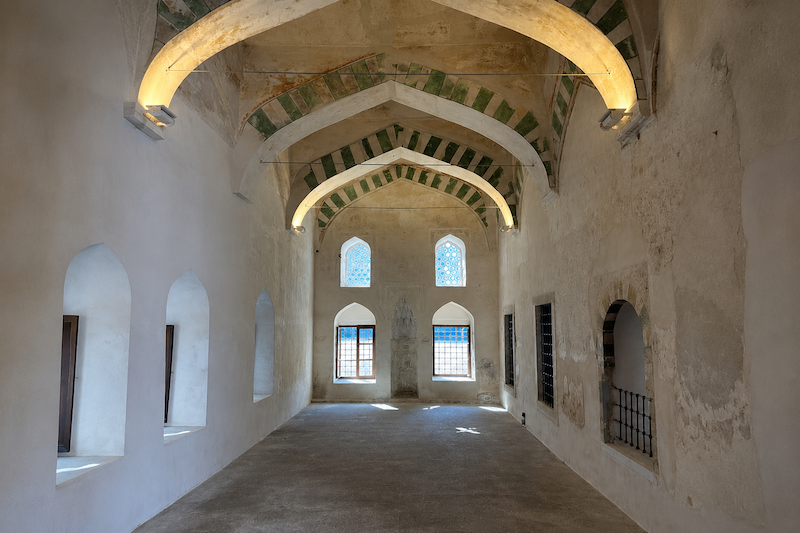
What first catches the eye at Hamza Bey Mosque is not simply its age, but the architecture itself. The mosque was built in 1467–68, just a few decades after the Ottoman conquest of Thessaloniki. Its original form was smaller, a neighbourhood mescit with a dome and a portico.
By the mid-16th century, the building had been expanded, gaining a colonnaded courtyard and a minaret and taking on the form of a large mosque that still stands out amid the dense urban fabric of the city centre.
And if you let your gaze rest on the columns of the courtyard, another story emerges. Among them are spolia, architectural elements from earlier buildings dating from Late Antiquity and the Byzantine period. In this way, old Thessaloniki is embedded within the monument itself.

At Hamza Bey Mosque, different eras of Thessaloniki meet within a building whose form and purpose changed along with the city.
The Alcazar before it became a memory
For decades, the colonnaded courtyard of Hamza Bey Mosque had a life very different from what one might expect of a 15th-century mosque. At 49 Egnatia Street stood the Alcazar, the popular cinema that would eventually give its name to the monument itself.
The first newspaper records of the Alcazar date from 1944, although the cinema had already opened by the end of 1932. The courtyard had been covered and the arcades incorporated into the cinema’s operation, creating a space unlike anything one might have encountered in another part of the city.
On the screen at the Alcazar appeared Marlene Dietrich in The Song of Songs, Gary Cooper in Marco Polo, Rudolph Valentino in The Son of the Sheik, and Ava Gardner and Gregory Peck in The Snows of Kilimanjaro. Later came Turkish and Egyptian films, particularly popular with Thessaloniki’s refugee community.
There were also those films that stayed in people’s memories. Writer Giorgos Ioannou recalled that he first saw Luis Buñuel’s Los Olvidados at the Alcazar. For a city that has always had a close relationship with cinema, screenings like these made the Alcazar something more than just another cinema along Egnatia street.
And shortly before the curtain fell for good, the Alcazar hosted one more unexpected evening. In 1983, the Thessaloniki-based band Cheimerinoi Kolymvites, led by Argyris Bakirtzis, at the Alcazar as part of the Dimitria Festival. Afterwards, the screen lit up once again for a film screening.
The cinema finally closed in 1988. The name, however, remained. For many Thessalonians, Hamza Bey Mosque is still the Alcazar, a name that connects the monument with an entire era of the city.

From the Alcazar to Kapani market
Just a few steps from Hamza Bey Mosque, central Thessaloniki reveals another side of itself. At Kapani, the city’s oldest open public market, stalls filled with fresh produce, spices, olives and fish sit alongside traditional cafés, bakeries and meze tavernas. It is a market that still carries the pulse of everyday life in the city.
Modiano market is once again opening its doors beneath its historic roof. The market returned in September 2026 with 32 shops, from a greengrocer, butcher and fishmonger to a bakery, cooked-food counters, places for tsipouro and meze, a coffee shop, pastry shop and bars. The historic market first opened in 1925 and quickly became one of the city’s meeting places. Today, almost a century later, it continues to be one of the most interesting culinary stops in the centre of Thessaloniki.

The Alcazar turns over a new leaf
During the first ten days of October, Hamza Bey Mosque is preparing to welcome visitors once again. Its first exhibition will be dedicated to the history of Thessaloniki and will inaugurate a new cultural chapter for the monument, through a collaboration between the Ephorate of Antiquities of Thessaloniki City and MOMus.

The dome, the large colonnaded courtyard, the arcades and the marble columns give Hamza Bey Mosque its distinctive character. Among the columns are also fragments from older buildings in Thessaloniki, reused in its construction. These are details worth noticing when the monument opens its doors once again.
After almost four decades behind the scaffolding, Hamza Bey Mosque is returning to the centre of Thessaloniki, this time as a place where the history of the city will meet contemporary culture once again.

